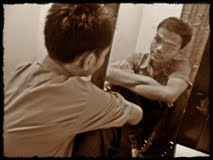
Let's travel back into the time when we were in junior/senior high school. Revisit our school that had given us many kind of stories. Enter our former class and sit over there. Remember when your English (or whatever subject you afraid of) teacher came to the class; what do you feel?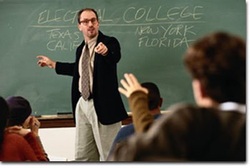
Yes, once upon a time (it sounds centuries ago ;-p ), I've ever had the unpleasant feeling when my English teacher come to the class. He very mastered his subject and is so kind, yet there's one thing made me afraid: he speaks so rapidly and loudly that made my friends and I felt as if he was a tribal elder who chanted incantations. He assumed that all of the students understand what he said, maybe. Whereas the fact, there's only a few students understand, including (I hope it won't sound arrogant,) me.
This small group students always become his target to talk and to tell some instructions in English, and then we spread it to another students in more 'understandable' language. Maybe he didn't realize it but actually I was uncomfortable with the treatment. Sometimes, he asked the whole class to make a group discussion while most of the students didn't know what they should do. According to you, was it effective?
I don't think so. We were asked to do something but he didn't give us any provision. We were stressed and feel threatened that we can't enjoy the class. Finally, we just got a little knowledge from his class. That's why, I'm really interested when Ms Vera showed us a video about Suggestopedia.
The setting and the way teacher teach make me impressed at the first time. I felt at home and enjoy the learning. I can record some new vocabularies and know the meaning at once because she performed some illustrations to describe the words. But then I think, I will need extra works to bring so many stuff into my class if I want to try this method in my class, one day. Besides, not all of Indonesian students like classic music. For some students, this kind of music can be a lullaby that will bring them into dream world. Moreover, if I apply this method in my class for the whole semester my students will be bored, I bet. They will laugh instead of study.
After Suggestopedia, I watched another method video, i.e. Silent Way (which is not really silent, actually), Audiolingualism, Communicative Approach, Community Language Learning, Total Physical Response. Every method has its uniqueness, advantages and disadvantages but not all of them can be applied in every classroom. None of them can be declared as the best one, I think. The best method is the most proper one with the condition of the class, either the place or the time.
I'm always impressed with method used by Pak Iwan. Even though I have known the methods used, it can feel new. As I know, he changes the strategies almost in every meeting. Maybe today we do debate, tomorrow we will make a literature circle or even a sketch! I also like the way he warms the class up and how he elicit us into a material. I wish I can be like him when I become a teacher, or even better.
Sunday, November 7, 2010 |
0
comments
Labels:
LTM reflection
Saturday, November 6, 2010 |
2
comments
These images came up into my mind at the first time I came to PETA class...
I was thinking, were all of them related to our future as a language teacher? I'm not studying history or geography!, shouted my mind at that time. Ten minutes after the lesson began, I started nodding my head; yes, this is what I need to be an extraordinary teacher. I have to pay attention to this course since I need many knowledge about PETA. Not Pembela Tanah Air or map, but Principle of Effective Teaching and Learning.
From the first meeting, Ms Tika showed us an original song made by Pak Iwan that motivate us to be an awesome teacher who never stop learning. Unfortunately, she didn't want perform that song for us :( . That song became such an eliciting that bring us into the next activity, describing the characteristics of effective teaching. The most interesting part is, we didn't have to look at a long list listed by the experts; we decided by ourselves what the characteristics are. Our previous experience helped us developing the list. By doing this, I can know what are the effective teaching according to my friends. Since our age is not far from Senior High School students, the answers can help me identifying what my students want later on. Some of them are:
- consider students' need
- well-prepared and complete resources
- supporting students' potencies
- focus on the basic objectives
Labels:
PETA reflection
I bet, You, the Digital Natives will laugh at that Ad. If we convert the price into recent Rupiah (6/10), it will cost >31 million rupiah. Nowadays, we can't do much with those bytes of memory--it's same with the size of 2 digital files, such as songs or pictures--but have you ever imagined that in July 1980 it was a BIG invention? It's just 30 years ago, and may be 30 years from now is our turn to be laughed by the next generation. Maybe, 50 years later the price of a Core2Duo notebook will be as cheap as a liter of rice. Even it's still be laughed because the gadget that's very sophisticated today will be the primitive one in their era.
Yes, we can see that digital technology runs so fast. However, do we run as fast as those gadgets?
Have we moved from "primitive" thinking way into the modern one? Do you know, somewhere there are some people who are so conservative that they reject the penetration of technology into their life. I got this point from the debate activity in the last session of TLL lecture. As the "con" side (we acted as if we're the school board), we had to argue the opposite group that tried to convince us using technology in our school. When we're on that position and tried to think conservatively, we found many reasons to reject that idea. From a paranoid thought that digital technology can decrease students moral value, make students lazy and depend on it, until the cliche reason, lack of infrastructure.
Actually, all of the reasons stem from their paradigm. As we know, to change someone paradigm is not easy. There are so many reasons influence it, e.g. the background of their life, education and also culture. Maybe they think that people in the past can also grab knowledge even though modern technologies haven't exist yet. Even the students they've taught for years without technology can achieve some great achievements, maybe.
However, will they stick on their argument if they see the movement progress from another school that optimize the usage of technology for learning? While their 'isolated' students can only hear the teacher to get knowledge, the other students can gain as many information as they want just by click-ing! While another students can create and share their own 'chemistry experimental video' , for example, they can only wait to get opportunity having their own experimentation.
Well, let's say they can accept the idea to apply technology, they may still have some problems that avoid them to do that, such as the lack of fund and infrastructure. I think, it's job of government and us to balance the condition. We (as teacher or teacher candidates) can contribute by introducing the application of technology in the classroom. I have a good news, in 2010, PT Telkom and Indonesian government is developing "Internet Masuk Desa" program so 5700 villages all over Indonesia can access Internet. Hopefully, by this innovation, Indonesian students can run as fast as technology, even one step ahead by creating new technology. Why not?

Labels:
TLL reflection
Friday, November 5, 2010 |
2
comments

Look at the baby! He's so cute, rite?
However, if you are a "digital immigrant",
you have to beware with him because
he is a "digital native"!
However, if you are a "digital immigrant",
you have to beware with him because
he is a "digital native"!
Yes, he is one of the Digital Natives that live on a new world with certain culture and rules. They have their own way and language to communicate each other. They can play with their friends even though they don't have any green field--virtual game! Yup, most of them live in virtual city but they are NOT a virtual creature. They are real, they were born by their mother, not be downloaded from internet.
Actually, their world is not far from us but there's a wall separate us: technology!This wall is flexible and never reject people who want to pass it. Anyhow, most people who immigrate to this world--they called Digital Immigrants--feel strange with the new situation and have some reluctance to accept everything offered to them. So, which one are you suppose to be; the Native or the Immigrant?
According to John Palfrey and Urs Gasser, in their book "Born Digital: Understanding the First Generation of Digital Natives", Digital Natives are the generation who was born after 1980 (or after technology was implemented in human life). While people born before that are Digital Immigrants who move to a new world to adapt and adopt the technology. For the Natives, digital technology is just like the air; they can't live without it. They use the technology almost in every activity.
Yeah, I was really impressed when Pak Iwan showed the video of this generation profile. It's very different with the past condition, even when I was in primary school. Digital natives can create some real project (not only to finish their school assignments, but also social work) productively with gadgets they have. They can also build good social relationship with their environment. So, it ruins some opinions that digital natives can only have fun with technologies. Great!
Therefore, since we are in 2010--means that we have entered their world--we (as a teacher candidates) have to prepare well to teach the next generation of Digital Natives. That's why I'm really eager to follow this course. I want to know further how technology can help me as a future English teacher at Senior High School. Hmm, I can't imagine how "futuristic" my students will be in 5 years later.
Fortunately, I found this video that gives us a little clue how to teach this amazing generation. Unfortunately, I can't show you the videos because of some technical problems. Anyway, I hope it helps!
Labels:
TLL reflection

When someone ask us the bad things from someone else, usually we can mention as many as we can write it down in pages of paper. But can we do the same when we asked the bad (also the good) things of ourselves?
Not all person can do that, so do I.
How do we know our strength and weakness? One of the best ways is by reflecting. I have done many things since I was a child, but sometimes those activities don't remain anything for me. That's why I need this blog to review what I've done and what I've learned so far, especially during I study in Sampoerna School of Education.
I'm sure, when I become an (awesome) teacher one day, I need these notes to reflect and I hope there will be many advantages I get.
Since I believe, experience is the best teacher.
Not all person can do that, so do I.
"The Longest Journey of any Person is the Journey Inward..."(Dag Hammerskjvld)
How do we know our strength and weakness? One of the best ways is by reflecting. I have done many things since I was a child, but sometimes those activities don't remain anything for me. That's why I need this blog to review what I've done and what I've learned so far, especially during I study in Sampoerna School of Education.
I'm sure, when I become an (awesome) teacher one day, I need these notes to reflect and I hope there will be many advantages I get.
Since I believe, experience is the best teacher.
Labels:
about this blog